Sumber ilustrasi: Unsplash
10 April 2026 11.45 WIB – Umum
_________________________________________________________________________________________________________________________________________________
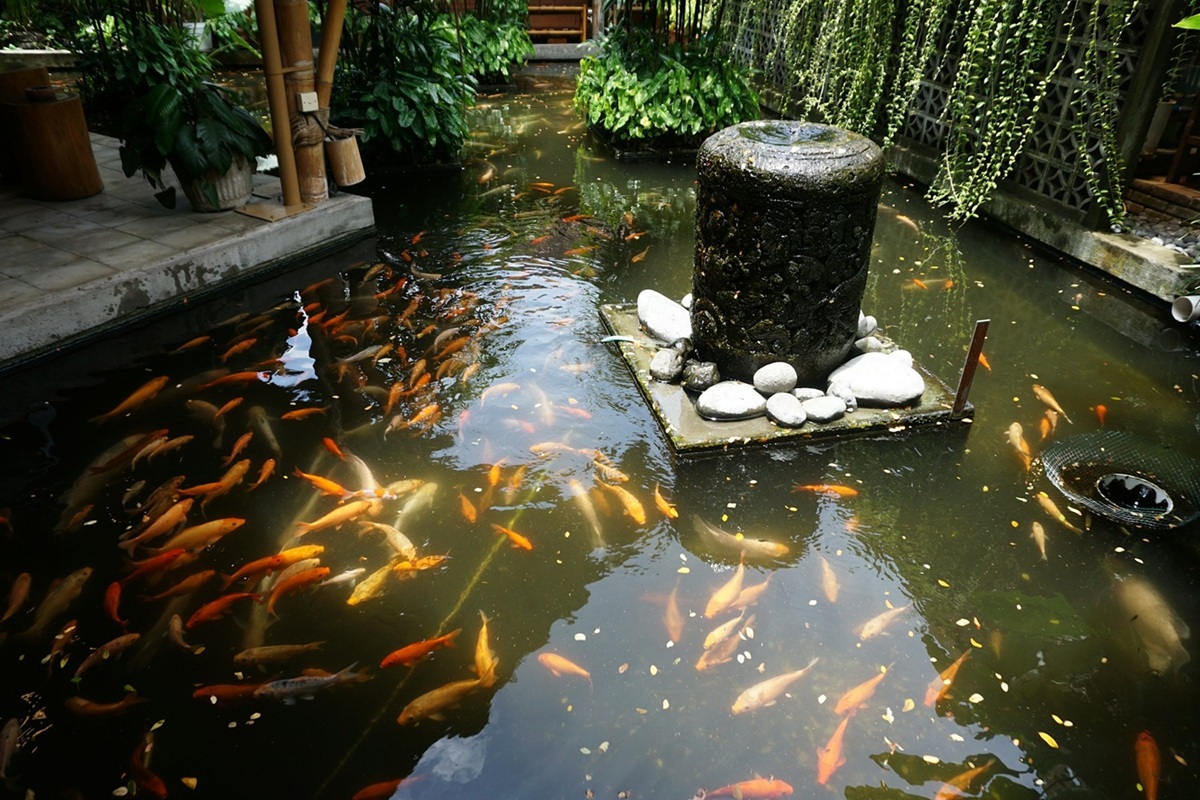
Desanomia [10.04.2026] Have you ever seen fish in a pond? Or perhaps you have a pond or aquarium at home with various kinds and colors of fish swimming in it? What do you see when you observe these fish? Are you captivated by their beauty? Have you ever considered the order at work within that pond? Have you ever carefully observed the fish’s movements? Where are they headed? Why don’t the fish collide with each other, or constantly bump into the pond walls?
What is actually happening? These questions may have disturbed your thinking. Have you grappled with these questions for a long time? Or perhaps, even now, as you read this, your thoughts are still wavering. How should these issues be understood? This essay aims to share one reflection. We can consider the following:
In a pond, fish live within a single space. That space is simultaneously a boundary and a possibility. The pond is not merely a place, but a condition that defines what can happen. All movement, interaction, and the continuation of survival unfold within this space; therefore, the world of fish is inseparable from the structures that shape it.
Fish movements are not random. Each movement is directed in the most likely direction, that is, the direction that maintains the continuity of its movement. This direction is not chosen by rational judgment, but arises from the compatibility of the fish’s body, the space, and the presence of other fish. Therefore, collisions do not become a dominant pattern, not because they are consciously avoided, but because they do not conform to the logic of movement that sustains life in the pond.
The relationships between fish form an order that is not designed. Each fish moves while intrinsically considering the presence of others, so distance, rhythm, and direction are mutually adjusted. This shared life is not the result of external rules, but the direct connection between beings that share the same living space.
The boundaries of the pond operate silently. The walls are not constantly consciously perceived, but they shape the direction of movement and function without being crossed. While the possibility of colliding with the walls or crossing the boundaries exists, this possibility does not result in an actual path. Rather, a movement unfolds that remains within the conditions under which life can be sustained.
What becomes clear from this is that the lives of the fish in the pond are not determined by unlimited freedom, but by the adaptation of movement to their living space. Freedom is not an impulse to cross boundaries, but manifests as the ability to move appropriately within given boundaries. When this adaptation is maintained, life can be sustained without destructive obstacles.
Its philosophical significance lies in the fact that if the relationship between existence and its space is in equilibrium, communal life does not require constant control. Order is not imposed from the outside, but emerges from within as a consequence of being in a mutually defining system. Boundaries do not negate freedom, but rather enable it to take a non-destructive form.
What do you think? (njd)
Note: This article was made as part of a dedicated effort to bring everyday life around us to our minds.