Sumber ilustrasi: Magnific
8 Mei 2026 11.07 WIB – Akar
_________________________________________________________________________________________________________________________________________________
Desanomia [08.05.2026] The case of the glass reveals something fundamental: human beings can hardly be separated from the things they have made themselves. The glass is merely one example. Yet from the glass the matter may be extended to sandals, cupboards, tables, clothing, houses, roads, books, money, vehicles, mobile phones, and the many other objects that compose everyday life. All these things initially appear as tools. Yet in actual life, such objects are not merely used by human beings; they participate in shaping the very manner of human existence.
For this reason, the question “is it possible for human beings to exist without the things they have made?” cannot be answered merely by saying that human beings would continue to survive biologically. The human body might indeed remain alive without glasses, sandals, cupboards, tables, or mobile phones. Yet such a human being would no longer be human in the form of life we presently recognise. What disappears is not merely convenience, but an entire way of living.
The things made by human beings function as intermediaries between humanity and the world. Through the glass, people do not merely drink, but come to know portion, presentation, cleanliness, and togetherness. Through clothing, people do not merely cover the body, but construct modesty, identity, propriety, and status. Through the house, people do not merely seek shelter, but distinguish inside from outside, family from stranger, privacy from the public realm. Through writing and books, people do not merely record, but transfer memory beyond the limits of the body itself.
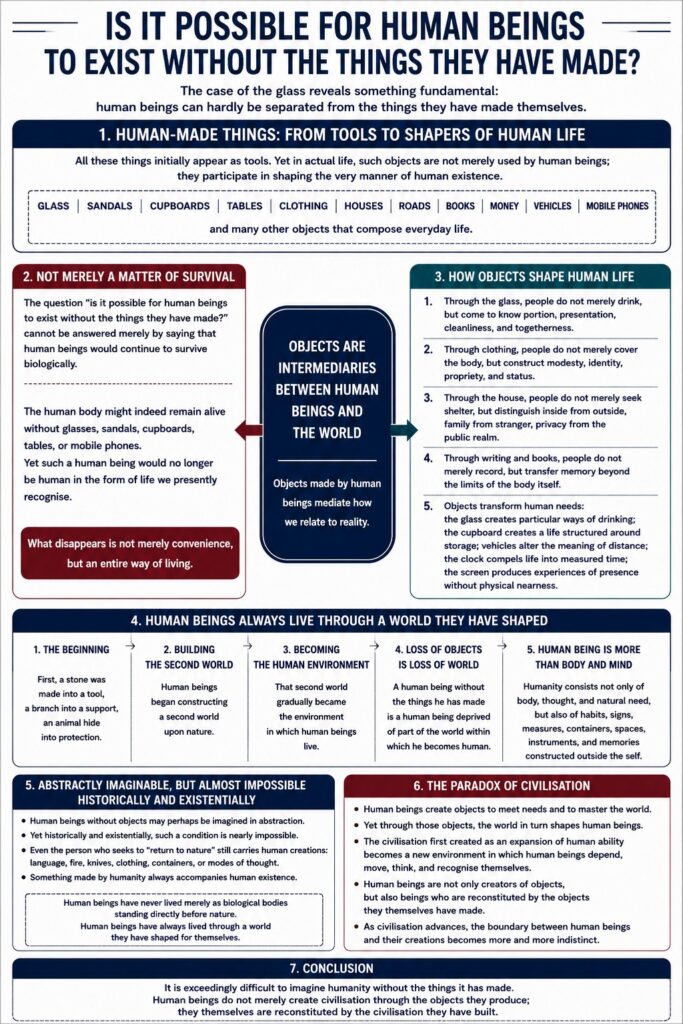
Thus, objects are not additions external to humanity. They are part of the manner in which human beings organise their relationship with reality. Human beings may indeed create objects out of necessity, yet once those objects come into being, human needs themselves are transformed. The glass creates particular ways of drinking. The cupboard creates a life structured around storage. Vehicles alter the meaning of distance. The clock compels life into measured time. The screen produces experiences of presence without physical nearness.
Here lies the impossibility. Human beings have never existed merely as biological bodies standing directly before nature. Humanity has always lived through a world it has shaped for itself. From the moment the first stone became a tool, the first branch a support, the first hide a covering, human beings began constructing a second world upon nature itself. That second world gradually became humanity’s own environment of existence.
A human being without the things he has made is not simply a human being deprived of tools. He is a human being deprived of part of the world within which he becomes human at all. For what is called “humanity” consists not merely of body, thought, and natural need, but also of habits, signs, measures, containers, spaces, instruments, and memories constructed outside the self.
For this reason, human beings without objects may perhaps be imagined in abstraction. Yet historically and existentially, such a condition is nearly impossible. Even the person who seeks to “return to nature” still carries human creations: language, fire, knives, clothing, containers, or modes of thought. Something made by humanity always accompanies human existence.
It becomes exceedingly difficult to imagine humanity without the things it has made. Human beings do not merely create civilisation through the objects they produce; they themselves are reconstituted by the civilisation they have built.
What do you think? (njd)
Note: This article was made as part of a dedicated effort to bring everyday life around us to our minds.