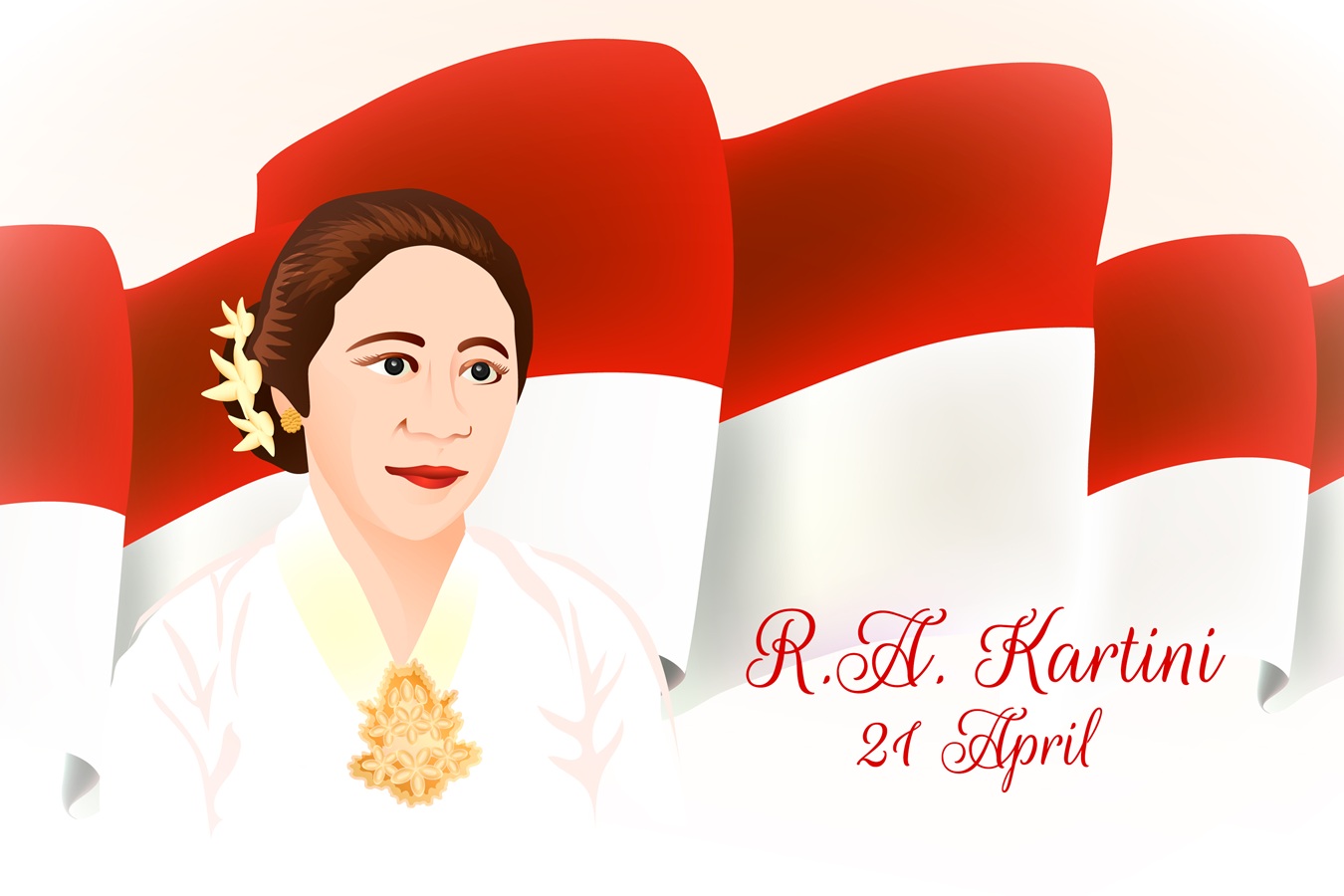
Sumber ilustrasi: Freepik
21 April 2026 14.50 WIB – Umum
_________________________________________________________________________________________________________________________________________________
Desanomia [21.04.2026] On the commemoration of Kartini Day, it is always marked by the wearing of traditional attire—an act that, at first glance, appears simple and ceremonial, even “traditional.” Some people carry out this practice as a routine activity, while others begin to question it. Does the use of traditional clothing truly align with the spirit of emancipation championed by Kartini?
It is at this point that a dialogue becomes necessary. Does such a tradition belong to the same space that Kartini once confronted, or does wearing traditional attire instead convey a contrary message? This practice, in fact, still opens a space for deeper reflection on the relationship between symbol, history, and the struggle for emancipation. Clothing is no longer merely an object, but a medium carrying layers of historical and normative meaning that remain open to reinterpretation.
Within a certain framework, traditional clothing may be understood as a “social text” whose meaning is never final. Each generation rereads the symbol according to its own context. Therefore, the kebaya or other traditional garments do not possess a single meaning: they may be seen as symbols of attachment to older norms, yet also as expressions of identity and the presence of women in the public sphere. Meaning, then, does not adhere permanently but emerges through a living process of interpretation.
Kartini’s spirit offers an important direction in reinterpreting this tradition. The emancipation that was pursued does not merely imply a break from tradition, but rather the capacity to process and transform tradition from within. In this sense, freedom is not identical with the rejection of symbols, but with mastery over their meaning.
The act of wearing traditional clothing thus acquires a performative dimension. It is not merely passive representation, but an action that reintroduces the history of struggle into the present. The body becomes a medium of articulation, and public space becomes an arena where meaning is negotiated. In this way, such an act holds the potential to revive collective awareness of the struggle for gender justice.
However, the relationship between tradition and emancipation is never simple. Tradition often carries traces of patriarchal structures that restrict women’s freedom. Therefore, the appropriate approach is not uncritical acceptance, but a dialectical stance capable of distinguishing between elements that oppress and those that can be empowered. Emancipation, in this sense, becomes a process of selecting and transforming meaning.
Within this context, gender justice is not only understood as a normative goal, but as an ongoing practice in everyday life. Wearing traditional clothing may become one form of that practice, insofar as it is carried out with critical awareness. Without such awareness, the symbol risks losing its emancipatory force and being reduced to mere cultural decoration.
The risk of ceremonialization remains a real challenge. When this practice is performed routinely without reflection, its historical and normative meaning fades. Traditional clothing becomes an empty formal sign, no longer containing critical power against unjust social structures. In such conditions, the symbol no longer liberates, but instead freezes meaning.
Conversely, when interpreted reflectively, traditional attire can serve as a bridge connecting the past, the present, and the future. It becomes a meeting point between the history of struggle and the hope for social transformation. Within what appears to be a simple act lies the possibility of reanimating the spirit of emancipation in a contextual and relevant form.
Happy Kartini Day. (njd)
Note: This article was made as part of a dedicated effort to bring gender perspective to our everyday life.