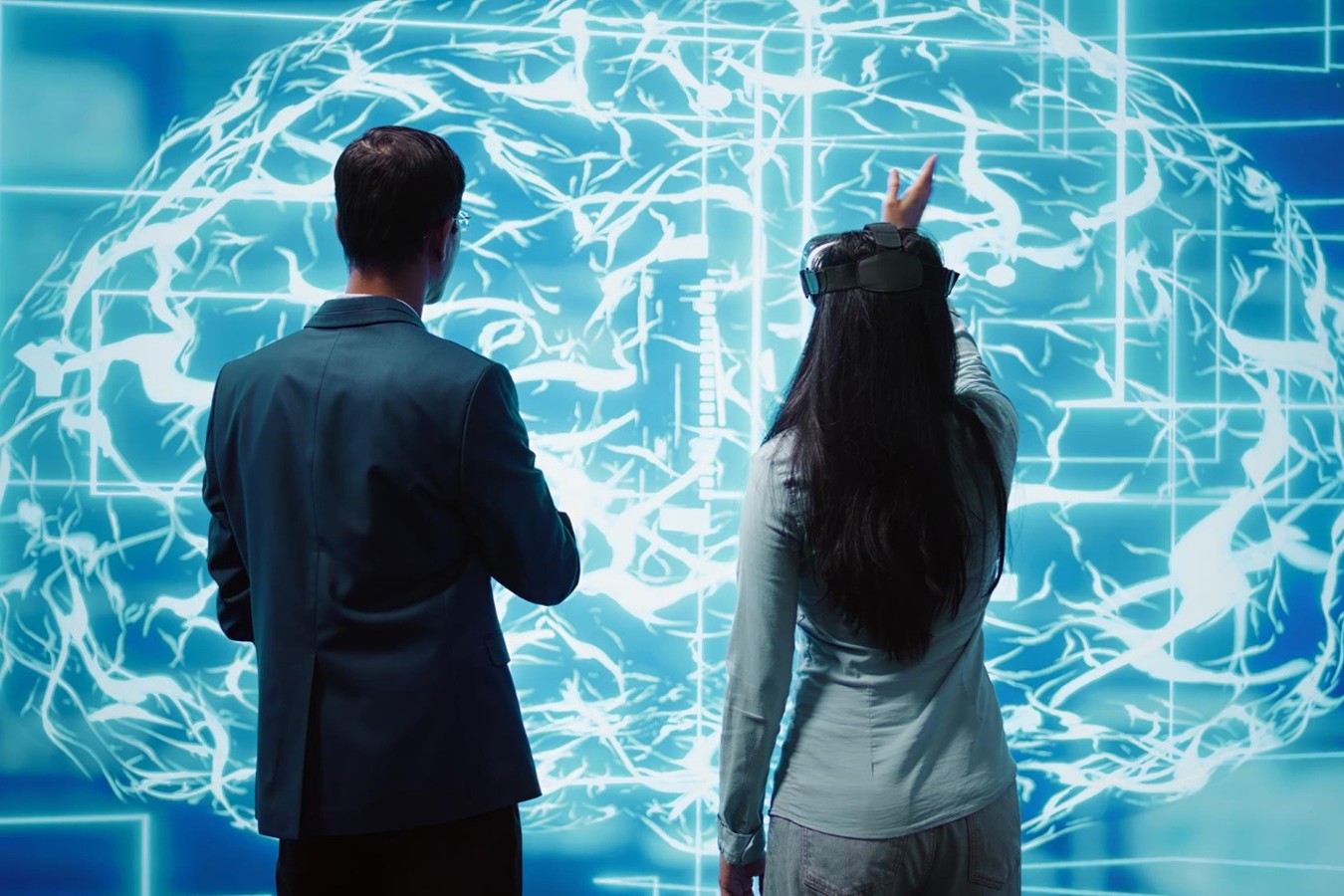
Sumber ilustrasi: Magnific
13 Mei 2026 09.33 WIB – Akar
_________________________________________________________________________________________________________________________________________________
Desanomia [13.05.2026]A question has come up that deserves a shared reflection: regarding cyberspace. The issue being raised is this: is cyberspace making our lives easier, or the opposite? Or perhaps something even deeper than that — namely that, without fully realizing it, cyberspace is shaping who we are, shaping our society, and perhaps even shaping our future? It is worthwhile to take a moment for reflection. The following sketch may become one possible reflection:
At first, cyberspace was imagined as a horizon of openness. Knowledge could move beyond national borders. Conversations could reach anyone. Information could be accessed with almost no distance at all. There was hope that humanity would become more enlightened because access to knowledge had become vastly wider.
Has that truly happened? Some among us have slowly begun asking a troubling question: why does a space once promised as a realm of openness so often turned instead into a space for attacks, manipulation, noise, and surveillance?
How should such a question, carrying the tone of a challenge, be answered? Is the problem really the technology itself, or is something more fundamental at stake? Some observers could argue that what often escapes collective attention is the fact that cyberspace has undergone a transformation. It is no longer merely a supporting tool, but has become part of a form of social engineering, with the direction of “shaping human beings.”
Because of that, the question shifts toward this: what kind of human being is now being shaped? In very real ways, cyberspace is shaping human beings who are constantly connected, and therefore increasingly unable to be fully present. The mind moves rapidly from one piece of information to another without remaining long enough in reflection. Human beings know many things, yet often lose the depth needed for understanding. Everything passes before the eyes as an endless stream.
Within that space, attention becomes a commodity. Emotions become data. Inner life is gradually translated into numbers, patterns, and predictions. What people like, fear, search for, and even doubt is recorded by systems. Human beings are no longer viewed solely as persons possessing inner dignity, but also as sources of data that can be processed and directed.
Under such conditions, cyberspace no longer functions merely as a communication tool. Cyberspace begins shaping the way people feel. Algorithms decide what deserves to be seen. Speed replaces contemplation. Reaction is valued more highly than wisdom. Anger spreads more easily than thoughtful silence.
Then a new kind of human being emerges: one whose attention is easily fragmented, easily reactive, easily exhausted inwardly, yet who continuously feels compelled to remain present within the digital stream. Digital presence becomes a kind of existential demand. Silence begins to feel like disappearance.
On the other hand, distance within cyberspace creates a moral paradox. A person can wound another without ever seeing the wounded face. Words can be thrown without sensing the weight of their consequences. Violence changes form into text, comments, information manipulation, or the destruction of reputation. Cyberspace makes actions feel light even though their impact may run very deep.
For that reason, attacks in cyberspace are not merely attacks against computer systems. The deepest attacks are often directed toward human consciousness itself. Attention is captured. Fear is cultivated. Perception is shaped. Truth is blurred until people struggle to distinguish reality from construction.
And yet cyberspace still carries another possibility. The same space may also become a place of learning, solidarity, the search for meaning, and conversations that deepen awareness. Everything depends on whether human beings are still capable of maintaining reflective distance from the technology shaping their lives.
Perhaps the most important question of our age is no longer whether technology is becoming more sophisticated. The real question is this:
as human beings spend more and more of life in cyberspace, are they still capable of dwelling within themselves?
Or are human beings slowly becoming creatures permanently connected to networks while increasingly disconnected from the depth of their own inner lives?
What do you think? Do you feel it too? (njd)
Note: This article was made as part of a dedicated effort to bring everyday life around us to our minds.