Sumber ilustrasi: Wikimedia Commons
15 Mei 2026 09.09 WIB – Akar
_________________________________________________________________________________________________________________________________________________
Desanomia [15.05.2026] Who does not know the game of petak umpet or hide and seek? It feels as though almost everyone has gone through a period of playing it. Why? Because hide and seek is a childhood game found across many places and cultures.
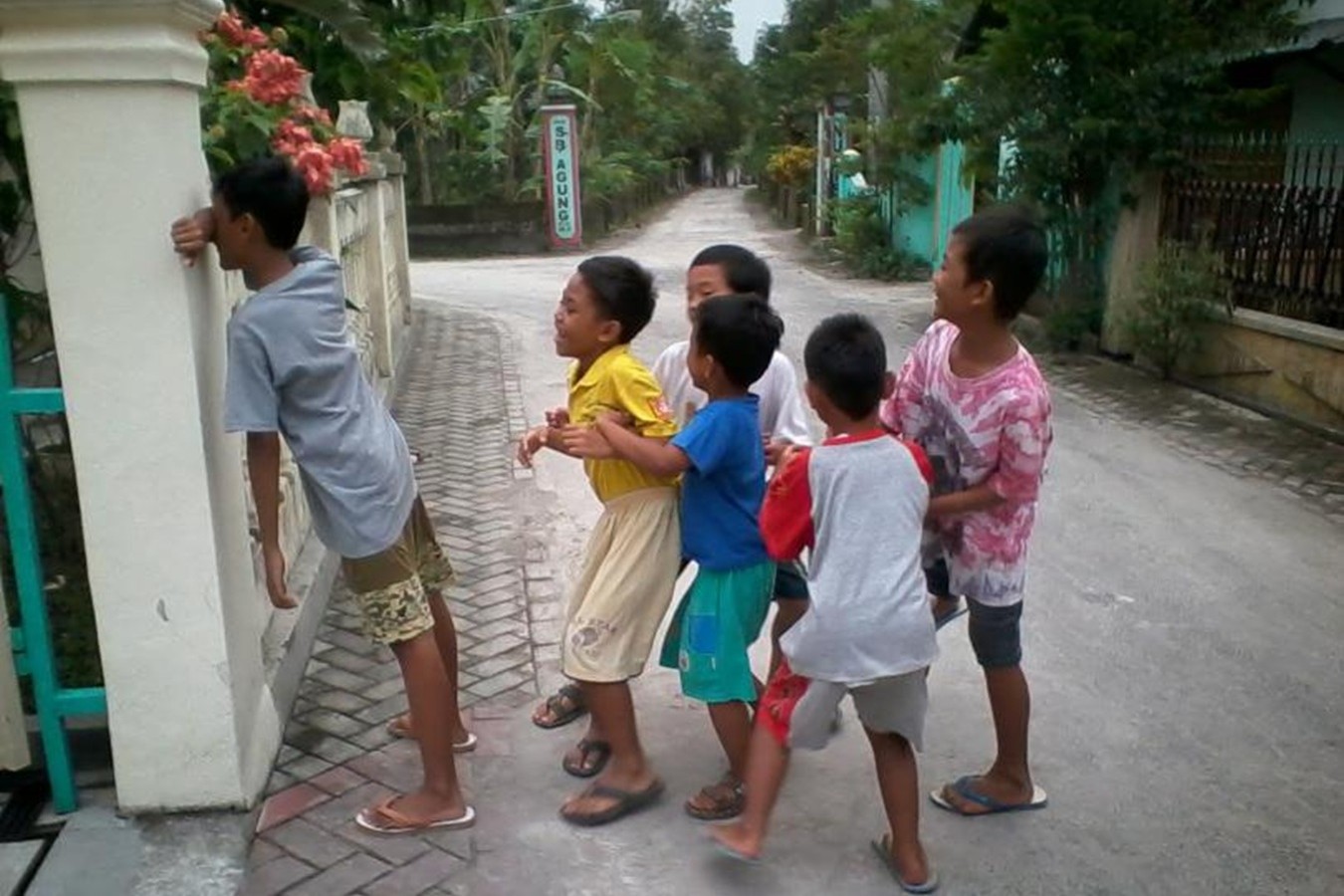
The form of the game is simple. A group of children gather together, then through a small draw or a counting game, one person is chosen as the seeker — usually the one who loses the draw. The seeker closes their eyes at a certain point — against a wall, a tree, a pole, or the corner of a house — while counting: one, two, three… At the same time, the other children quickly scatter to find hiding places.
Once the counting ends, the seeker begins moving through the playing area. Eyes inspect corners, ears listen for small sounds, and the body slowly builds guesses about where the hidden children may be. On the other side, those hiding hold their breath, maintain position, observe the seeker’s movement, and occasionally look for chances to shift position without being seen.
The game becomes interesting because the whole environment changes function. A tree is no longer just a tree, a chair no longer just a chair, and a corridor no longer simply a passageway. Everything turns into possibility: a shelter, a lookout point, an escape route, or a trap of visibility. Ordinary space suddenly becomes strategic space.
Sometimes the seeker finds someone quickly. Sometimes the search goes on for quite a while. Some lose because they choose the wrong spot. Others succeed because they can read the direction of the seeker’s gaze. Some quietly change position when the seeker becomes distracted. The entire game moves through changes of position and attempts to read position.
Because of that, the essence of hide and seek is not only hiding or searching. Something more fundamental is taking place: the development of orientation. Children learn to understand space through direct involvement. They learn distance, perspective, visibility, possible movement, and the relationship between bodily position and surrounding environment.
Within the game, “where?” becomes the most important question. The seeker constantly asks in silence: where are the others? Meanwhile those hiding also silently ask: where is the safest position? Both sides exist within the tension of orientation.
Interestingly, orientation in hide and seek is never absolute. A safe place may suddenly become dangerous simply because of a change in perspective. A wall may provide protection from one direction while exposing visibility from another. Position therefore is always relational. Something is only safe or visible in relation to another position.
The game quietly teaches that space is not only geometric emptiness. Space is a field of possibilities. A small backyard may feel vast when filled with hiding opportunities, while a large area may feel narrow when no protection is available. The experience of space emerges from lived relations with the environment.
Hide and seek also shows that human beings first learn the world through the body. Children do not initially understand space through theory, but through movement: running, crouching, peeking, hiding, and shifting position. The body becomes the first centre of orientation for experiencing the world.
Because of that, the game actually contains a very old philosophical lesson: all human experience unfolds from a certain position. No perspective is completely neutral. The world appears differently depending on where it is viewed from. What remains hidden from one position may appear entirely obvious from another.
At a deeper level, hide and seek also contains a relationship between existence and visibility. Something does not cease to exist just because it cannot be seen. A child hiding remains present within the game despite being invisible. Hidden within that is an early lesson that reality is always wider than what directly appears before the eyes.
The game also shows that knowledge emerges through searching. The seeker does not know the positions of others from the beginning. Knowledge is built gradually: through traces, sounds, guesses, shifting shadows, or intuition about spatial possibilities. To know means to navigate uncertainty.
What is fascinating is that almost everyone experiences a game like this during childhood. That means orientation is learned very early within human social life. Before learning theories of space, human beings already learn to live within structures such as “here”, “there”, “near”, “far”, “visible”, and “hidden”.
Because of that, it is not surprising that many modern institutions use the term “orientation period”. New university students entering campus experience something quite similar to children playing hide and seek. A new environment initially appears unfamiliar and without a clear map of meaning. Buildings, rules, social relations, and academic structures still feel uncertain.
An orientation period, at its core, is the process of forming “where”. It is not only about knowing the location of classrooms or libraries, but about understanding one’s position within a new world. A person begins learning directions in life, social relationships, structures of knowledge, and possible futures opening within that environment.
What do you think? (njd)
Note: This article was made as part of a dedicated effort to bring everyday life around us to our minds.