Sumber ilustrasi: Wikimedia Commons
15 Mei 2026 11.09 WIB – Akar
_________________________________________________________________________________________________________________________________________________
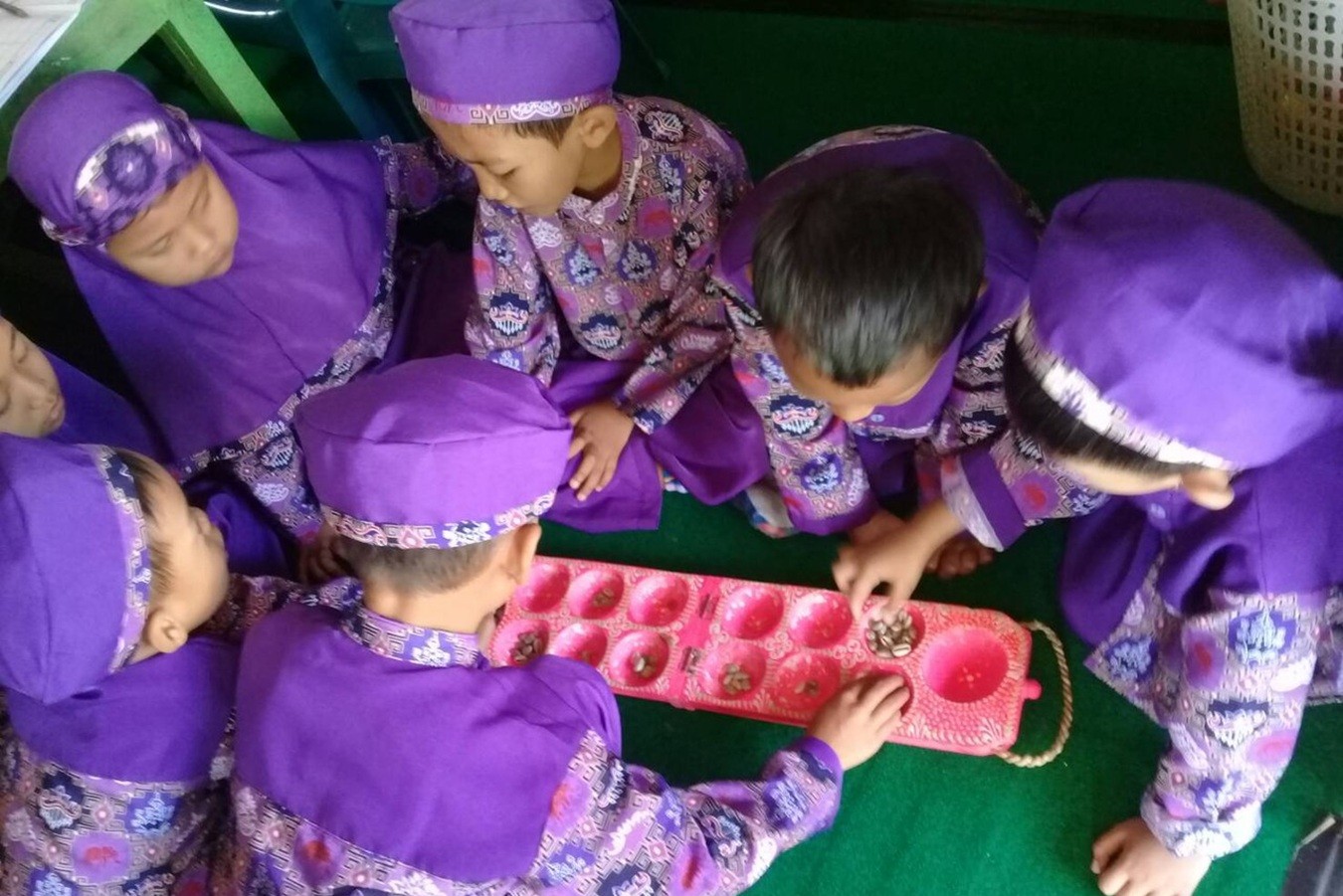
Desanomia [15.05.2026] Congklak, or dakon, is a traditional game played by two people using a long board made of wood, plastic, or other materials. In its classic form, the congklak board is carved from wood and shaped lengthwise, containing rows of small holes on both sides and two larger holes at each end. The small holes usually number 14 in total, with 7 on each player’s side, while the two larger holes are called the “home” or “storehouse”. The playing pieces may consist of small shells, stones, sapodilla seeds, tamarind seeds, tiny marbles, or other small objects that can easily be held and moved by hand.
Before the game begins, each small hole is filled with the same number of pieces, usually 7. The large holes, or homes, remain empty. The two players sit facing one another, each controlling the row of small holes directly in front and one home positioned at the end of the board. The goal of the game is to collect as many pieces as possible into one’s own home. From the very beginning, the congklak board already forms a miniature world with sides, boundaries, directions, pathways, and centres of purpose.
The game begins when one player takes all the pieces from a chosen small hole on their side. The pieces are then dropped one by one into the next holes according to the agreed direction, usually circling around the board. A player places pieces into their own small holes, the opponent’s small holes, and their own home, but skips over the opponent’s home. The movement of pieces does not happen all at once, but gradually, one hole at a time, so that every move creates a rhythm of counting and movement.
If the final piece lands in a hole that already contains other pieces, all pieces from that hole are picked up again and the turn continues from there. This sequence may repeat several times until the final piece lands in a position that ends the turn. Because of that, a single turn in congklak is not always brief. One initial decision can create a long chain of movement, depending on the number of pieces and the position of the final hole.
If the last piece lands in one’s own home, the player usually receives another turn. If the last piece lands in an empty hole on one’s own side, the player may capture the opponent’s pieces directly opposite that hole and place them into the home. However, if the last piece lands in an empty hole on the opponent’s side, the turn ends without additional gain. The game continues until the small holes no longer contain pieces to play. The winner is determined by whoever gathers the most pieces inside the home.
From this description, it becomes clear that congklak is not just a game of taking and moving pieces. The entire game quietly revolves around one hidden question: where will the final piece land? This becomes the strategic centre of congklak. Players not only observe which holes are full or empty, but calculate trajectories, predict the ending position of movement, read opportunities to capture the opponent’s pieces, and avoid positions that benefit the opponent.
Within the optic of “where”, congklak becomes a form of orientation training quite different from hide and seek. Hide and seek teaches bodily orientation within open space, while congklak teaches orientation of distribution within patterned space. The body does not run, but the mind moves together with the pieces. What matters is not hiding places, but points of landing, stopping, continuation, and capture.
The congklak board also demonstrates that space is never neutral. Every hole gains meaning through its position within the sequence. A hole that appears ordinary may suddenly become important when it becomes the landing point of the final piece. An empty hole may become an opportunity if positioned on one’s own side and facing a full hole belonging to the opponent. The home functions as a centre of accumulation, while the small holes function as spaces of circulation. In that sense, the value of a place is determined by relation, direction of movement, and the possibilities opened through it.
Congklak further teaches that ownership cannot simply be understood as static assets. The pieces constantly circulate, moving from one hole to another, entering one’s own home, passing through the opponent’s territory, and repeatedly forming new arrangements. Wealth within the game is not only the number of pieces possessed at a single moment, but the ability to understand circulation itself. What matters is not only how much is owned, but how distributional movement can be directed.
Because of that, congklak or dakon contains a subtle form of wisdom: life does not merely unfold within space, but within continuously shifting distributions of position. Every decision changes the arrangement of the small world on the board. Every piece carries consequences because it lands in a particular place. Through wooden boards, carved holes, and tiny pieces, children quietly learn counting, patience, honesty, possibility, boundaries, and the understanding that the question “where” concerns not only bodily location, but also the movement of resources, the “fate” of distribution, and the strategy of position and existence itself.
Do you see the same thing, or perhaps hold a different view? (njd)
Note: This article was made as part of a dedicated effort to bring everyday life around us to our minds.