Sumber ilustrasi: Pixabay
24 April 2026 09.05 WIB – Umum
_________________________________________________________________________________________________________________________________________________
Desanomia [24.04.2026] Earthquakes often understood simply as “shaking from within the ground.” This expression is not entirely wrong, but it does not answer the more fundamental question: what actually causes the ground to shake?
In the study of earth science, earthquakes are explained as the result of the release of energy stored within the Earth’s crust. The crust is not a static layer, but part of a dynamic system that continuously undergoes stress and change due to the movement of large plates.
The Earth’s surface is composed of several tectonic plates that move very slowly, typically only a few centimeters per year. This motion continues over very long geological timescales. This explanatory framework is known as plate tectonics.
Interactions between these plates are the key factor. At plate boundaries, three types of movement can occur: moving toward each other (convergent), moving apart (divergent), or sliding past one another (transform). These movements do not always proceed smoothly because of friction and locking along fault zones.
Due to this resistance, mechanical energy accumulates within the rocks. Rocks have elastic properties, allowing them to store energy up to a certain limit. When the stress exceeds the strength of the rocks, a sudden shift occurs along a fault. This mechanism is known as elastic energy release.
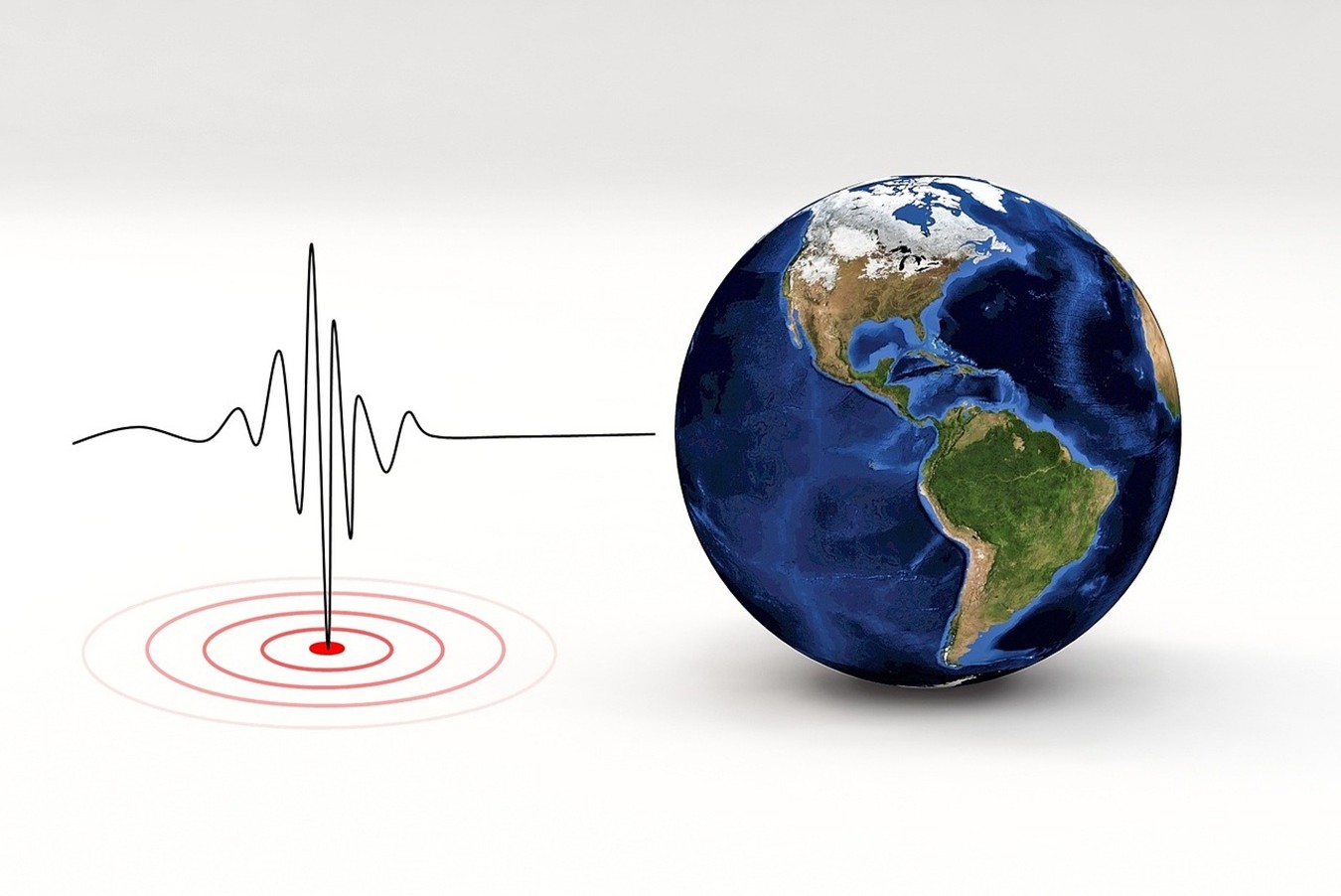
The released energy travels through the Earth in the form of seismic waves. The shaking felt at the surface is the result of these waves propagating through the ground. The point within the Earth where the energy is released is called the hypocenter, while the point directly above it on the surface is called the epicenter.
Most earthquakes are associated with tectonic activity. However, there are also volcanic earthquakes triggered by the movement of magma within volcanoes, as well as collapse earthquakes, which are usually small and caused by the failure of underground cavities. In addition, some earthquakes are induced by human activities, such as fluid injection or mining operations, though these are generally more limited in scale.
In common understanding, earthquakes are often seen as sudden events. In fact, an earthquake is not simply the result of a “sudden shift,” but the outcome of a long process of stress accumulation that is then released rapidly. Without this accumulation, a shift would not produce a significant earthquake.
What do you think? (njd)
Note: This article was made as part of a dedicated effort to bring everyday life around us to our minds.