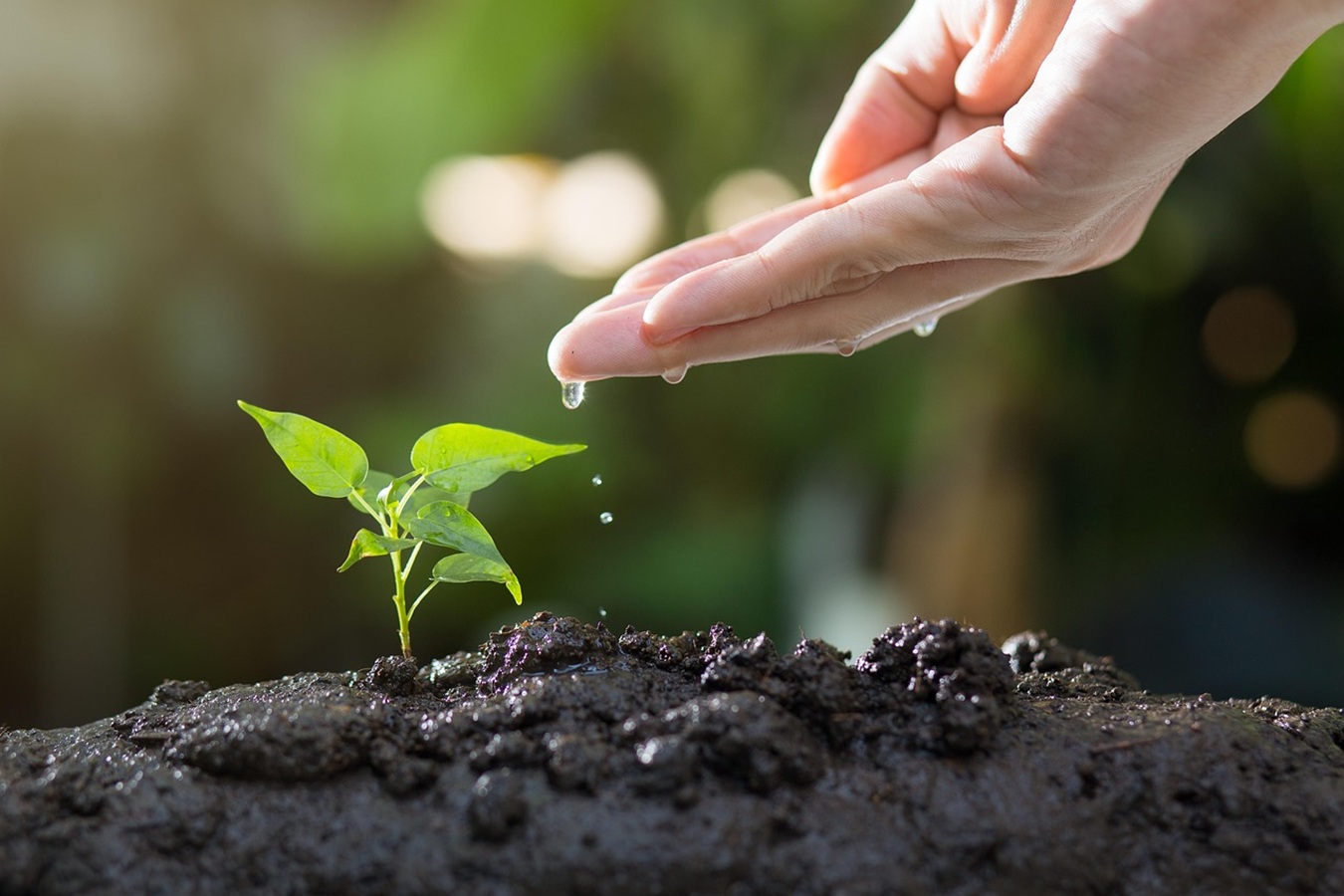
Sumber ilustrasi: Pixabay
24 April 2026 08.50 WIB – Umum
_________________________________________________________________________________________________________________________________________________
Desanomia [24.04.2026] A simple question that arise from everyday conversation: where does the mass of a plant come from, such that from a tiny seed it can grow into a large plant with abundant fruit? From a seed weighing only a few grams, it can become a plant weighing hundreds of kilograms or even many tons. How would you answer this? Would you tend to say that all of it comes from the soil? Or that the soil in which the plant grows is the source of its mass? Is this answer correct?
We must admit that such an answer is the most common. Why? Because that is what appears to us. Plants grow in soil; therefore, the soil is assumed to be the primary source of their mass. Intuitively, this feels right, since the soil is where the roots take hold and from which the plant seems to “take” something.
But is it really so? Or is this intuition misleading because it rests only on what is visible?
Within the framework of biology, plant growth is not merely a matter of location, but a process of accumulating matter. The more precise question is: where do the materials that form the plant’s body come from? In other words, we must distinguish between the place where growth occurs and the source of its substance.
Soil does indeed play an important role. It provides minerals such as nitrogen, phosphorus, and potassium that are necessary for biological functions. However, in terms of total mass, the contribution of these minerals is relatively small. Soil is better understood as a supplier of supporting elements, not the primary material from which the plant’s body is built.
Water is also often considered the main source because of its vital role. Without water, there is no growth. Yet water primarily acts as a solvent, a transporter of substances, and a participant in internal reactions. Once water is removed, most of the plant’s solid structure remains, indicating that water is not the main contributor to its dry mass.
The key explanation lies in the process of photosynthesis. In this process, plants absorb carbon dioxide from the air and convert it into organic compounds. The carbon from the air becomes the main framework of plant tissues.
As a result, most of a plant’s dry mass actually comes from the atmosphere. Plant growth can be understood as a process of transforming gaseous substances into solid structures using light energy. What was once invisible becomes tangible as stems, leaves, and roots.
Experimental observations show that plants can grow significantly without a corresponding decrease in the mass of the soil. This fact reinforces that soil is not the main source of the increase in mass, but rather one of the conditions that make growth possible.
Analytically, the common error arises from equating the place where a process occurs with the source of its material. Soil is a medium and support, but not the primary source of the substance that composes the plant’s body.
What do you think? (njd)
Note: This article was made as part of a dedicated effort to bring everyday life around us to our minds.