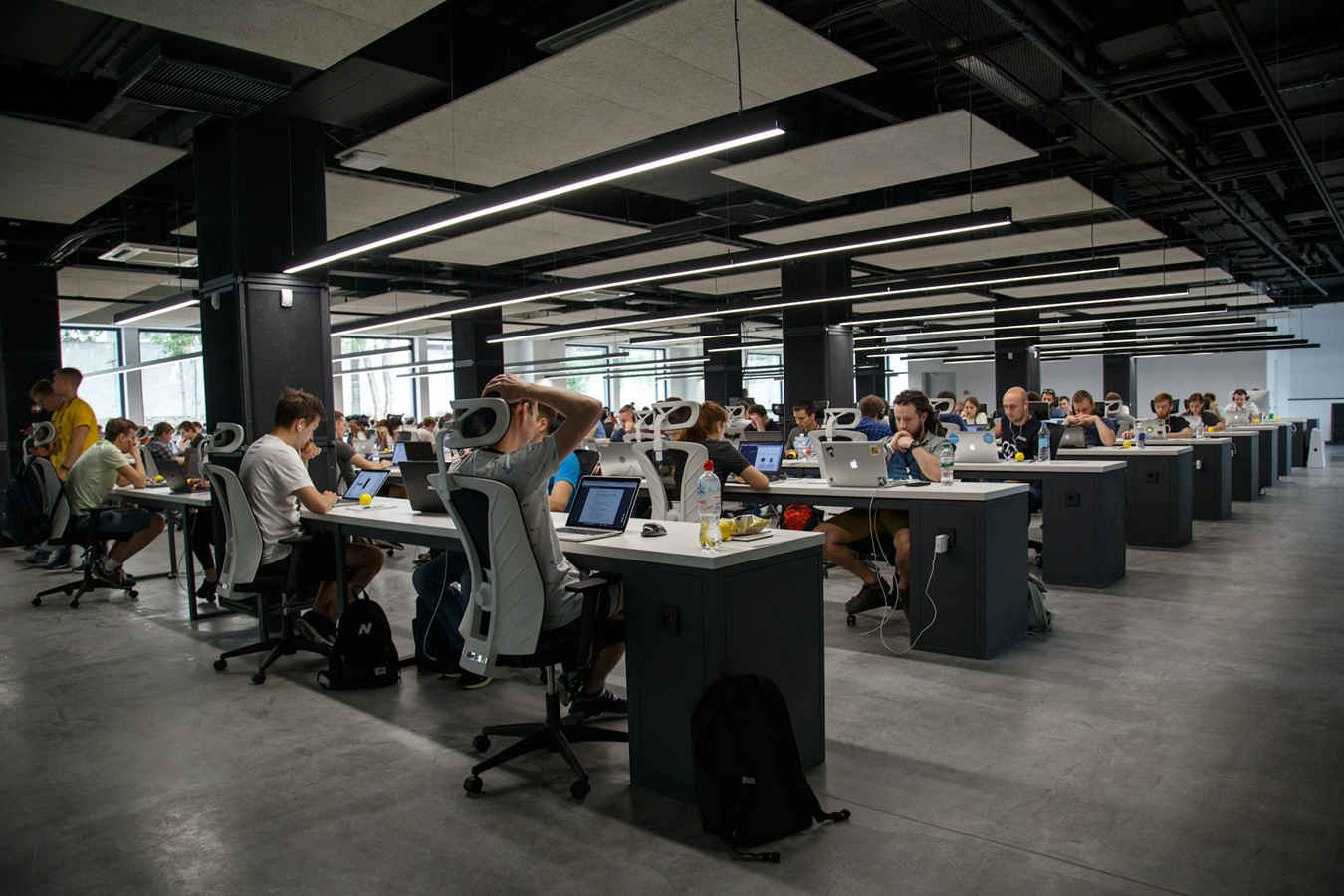
Sumber ilustrasi: Unsplash
28 April 2026 12.05 WIB – Umum
_________________________________________________________________________________________________________________________________________________
Desanomia [28.04.2026] The emergence of the issue regarding the potential closure of several academic programs deemed misaligned with “industry” has sparked public discussion from various perspectives. One central point of reflection concerns the very notion of employment. Is employment ideally structured by industry, with universities merely serving as providers of labor? Or should universities be understood as a kind of womb for the birth of whole human beings, rather than mere job applicants?
This reflection begins from the view that employment should correspond to those who seek it. In other words, job seekers are, ideally, the ones who understand themselves best. If employment ought to serve the subject who seeks work, then the most ideal condition would be that job seekers themselves shape forms of work that align with their own nature.
Is such a possibility realistic? It becomes clear that the idea of employment as something produced by job seekers themselves shifts the common understanding of work. The focus moves away from job availability toward the human capacity to create forms of work out of one’s own potential. The world is no longer seen as a provider, but as a field of creation and innovation.
However, this view cannot stand without critical reflection on existing labor structures. Many modern forms of work still contain relations that place human beings in subordinate positions. In this context, applying for a job can be seen as the beginning of a relationship that limits freedom.
Applying for a job presupposes the existence of an external authority that determines one’s value. The selection process becomes an entry point into a pre-structured system. From the outset, the applicant stands within a framework of adjustment, not creation.
For this reason, the idea of creating work becomes important as a form of resistance against dependency. Creating work contains an element of freedom, as it arises from initiative and the ability to form productive relations independently.
Yet this freedom cannot be separated from structural realities. Not everyone has equal access to resources. Therefore, the creation of work must be understood as an orientation that requires support from broader systemic change.
On that note, the demand for transformation in the twenty-first century emerges. The structure of employment should not merely be expanded, but fundamentally reshaped. Relations resembling subjugation need to be replaced with relations that enable participation and creation—relations grounded in equality.
Residues of servitude within modern labor often do not appear explicitly. They manifest in total dependence on wages, alienation from the results of one’s labor, and the loss of control over the production process. Under such conditions, work loses its meaning as an expression of the self.
The transformation sought is not merely technical, but involves a shift in how human beings are understood within work. Human beings are not tools of production, but subjects capable of determining the direction of their lives.
Within this framework, higher education holds a strategic position. If education merely prepares graduates to apply for jobs, then it reinforces existing structures. Its function becomes narrow and reductive.
Conversely, education can serve as a space for forming individuals capable of creation. Knowledge is not only used to meet job requirements, but to open new possibilities within productive activity.
Universities, in this sense, become spaces for cultivating awareness. Awareness that work is not merely an economic obligation, but also a space for realizing human potential. From this emerges the courage not only to follow, but to shape.
However, transformation does not occur instantly. Economic, social, and cultural limitations continue to play a role. Therefore, change must be understood as gradual and layered.
Awareness of power relations within work also becomes crucial. Without such awareness, individuals easily accept unjust structures as natural. With awareness, choices become more reflective.
Even when someone chooses to apply for a job, that choice can be understood as a strategy rather than absolute submission. One’s position within a structure does not necessarily determine how one understands oneself.
Ultimately, the question of work becomes a question of freedom and responsibility. The freedom to create must be balanced with the responsibility to understand real conditions. Without this balance, the idea of freedom risks turning into illusion.
What do you think? (njd)
Note: This article was made as part of a dedicated effort to bring everyday life around us to our minds.