Sumber ilustrasi: Magnific
20 Mei 2026 12.04 WIB – Akar
_________________________________________________________________________________________________________________________________________________
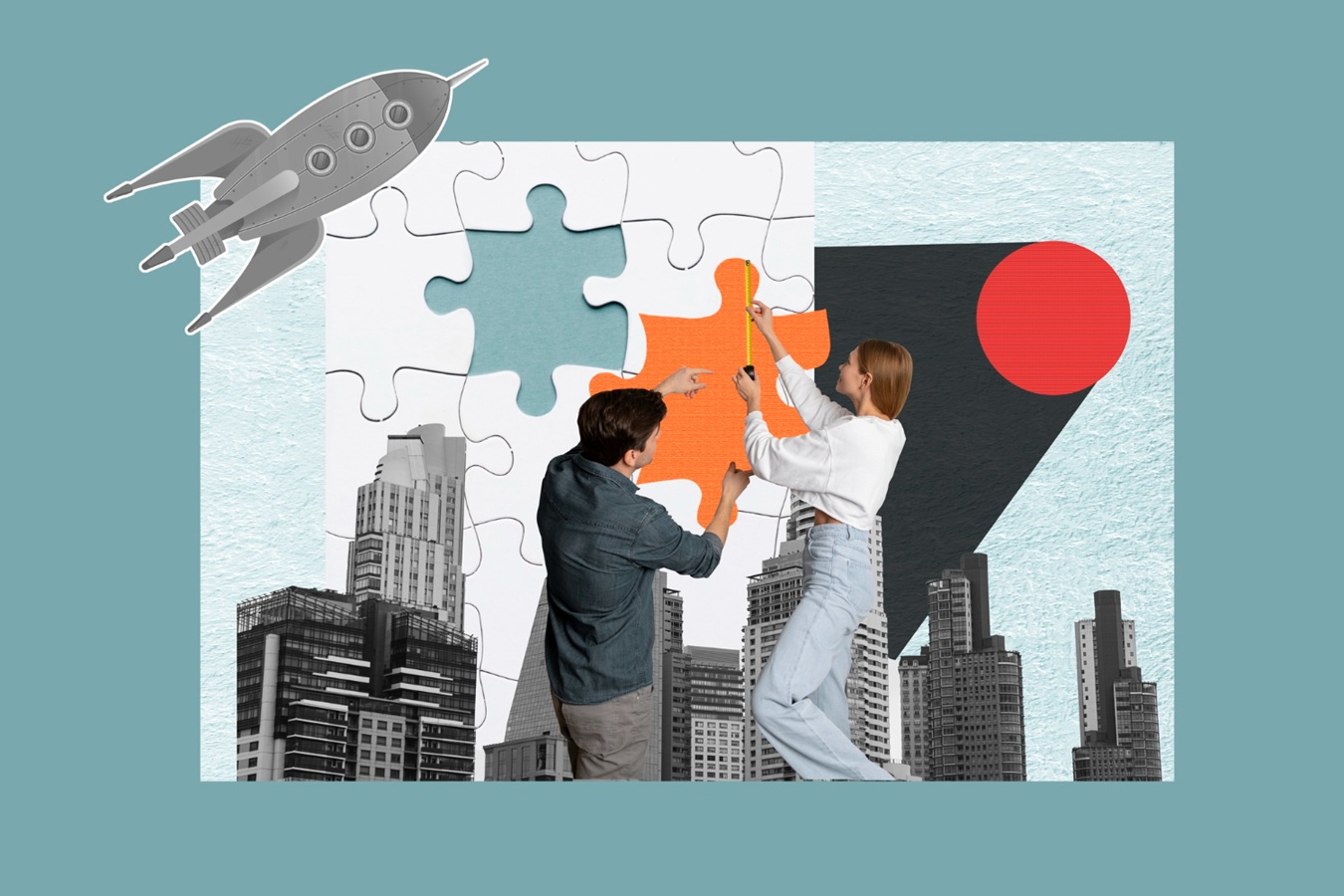
Desanomia [20.05.2026] If a puzzle game has its final picture already available, what if reality does not work in the same way? What if human beings live among scattered pieces without ever truly seeing the whole picture? This question opens a deeper reflection: is it possible that reality works like a puzzle, but without a final image being given beforehand?
In such a condition, human beings no longer assemble a puzzle by following an already available picture. Instead, they must assume that a certain image may perhaps be formed from the pieces that are found. In other words, the larger picture is not given, but imagined, assumed, and then tested through the process of arrangement.
Perhaps this is how science itself works. For thousands of years, scientists have essentially worked like assemblers of a gigantic puzzle. They gather pieces in the form of observations, experiments, data, symptoms, patterns, and anomalies. From these fragments, human beings attempt to construct an image of how the world works.
However, unlike an ordinary puzzle game, scientists never truly possess certainty that all the pieces come from the same picture. Some data may be relevant, some may be mistaken, some may result from limitations of measurement, and others may belong to entirely different phenomena. Because of this, science does not merely arrange pieces, but continuously sorts which pieces are considered important and which must be discarded.
If we look at an ordinary puzzle, the correctness of a piece can immediately be checked against the final picture. In science, the final picture itself is built from patterns of compatibility believed to emerge among certain data. Because of that, scientific theory is fundamentally an effort to construct order from scattered fragments of reality.
From this process emerge theories, models, scientific laws, paradigms, and even grand theories. All of these are human attempts to form a larger picture so that various phenomena may be understood within a relatively unified framework. When a theory succeeds in explaining many phenomena at once, people gain the impression that the picture of reality is beginning to appear more clearly.
Yet the history of science shows that pictures once regarded as complete often change. A theory that once seemed capable of explaining everything may later be questioned by new discoveries. New pieces appear and force the rearrangement of older pictures. In this sense, science is not a final completion, but an ongoing process of arrangement.
This reveals a fundamental difference between the puzzle game and the puzzle of reality. In a game, the picture determines the arrangement of the pieces. The arrangement of pieces in science is instead used to construct a hypothesis about the picture. Because of this, scientific pictures are always provisional and open to revision.
Furthermore, it is possible that what is called the “larger picture” is itself only one fragment of an even greater and more complex picture. A grand theory may appear complete in its own era, yet later be understood only as a small fragment within a much broader structure of reality. What was once considered central may later become peripheral as the horizon of knowledge expands.
Science moves within a unique tension. On one hand, it requires the assumption that reality possesses an order that can be understood. Without such an assumption, the construction of knowledge would become impossible. Yet on the other hand, science must also acknowledge that every arrangement of knowledge may still fall short of being the final picture of reality itself.
What is being suggested here is that human beings most likely live within a puzzle that is never completely finished. New pieces continue to be discovered, pictures continue to be revised, and horizons continue to shift. What is called knowledge may not be the possession of a final picture of reality, but rather the human capacity to continuously arrange, correct, and expand the pictures that have so far been constructed.
What do you think? (njd)
Note: This article was made as part of a dedicated effort to bring everyday life around us to our minds.