Sumber ilustrasi: Magnific
20 Mei 2026 09.23 WIB – Akar
_________________________________________________________________________________________________________________________________________________
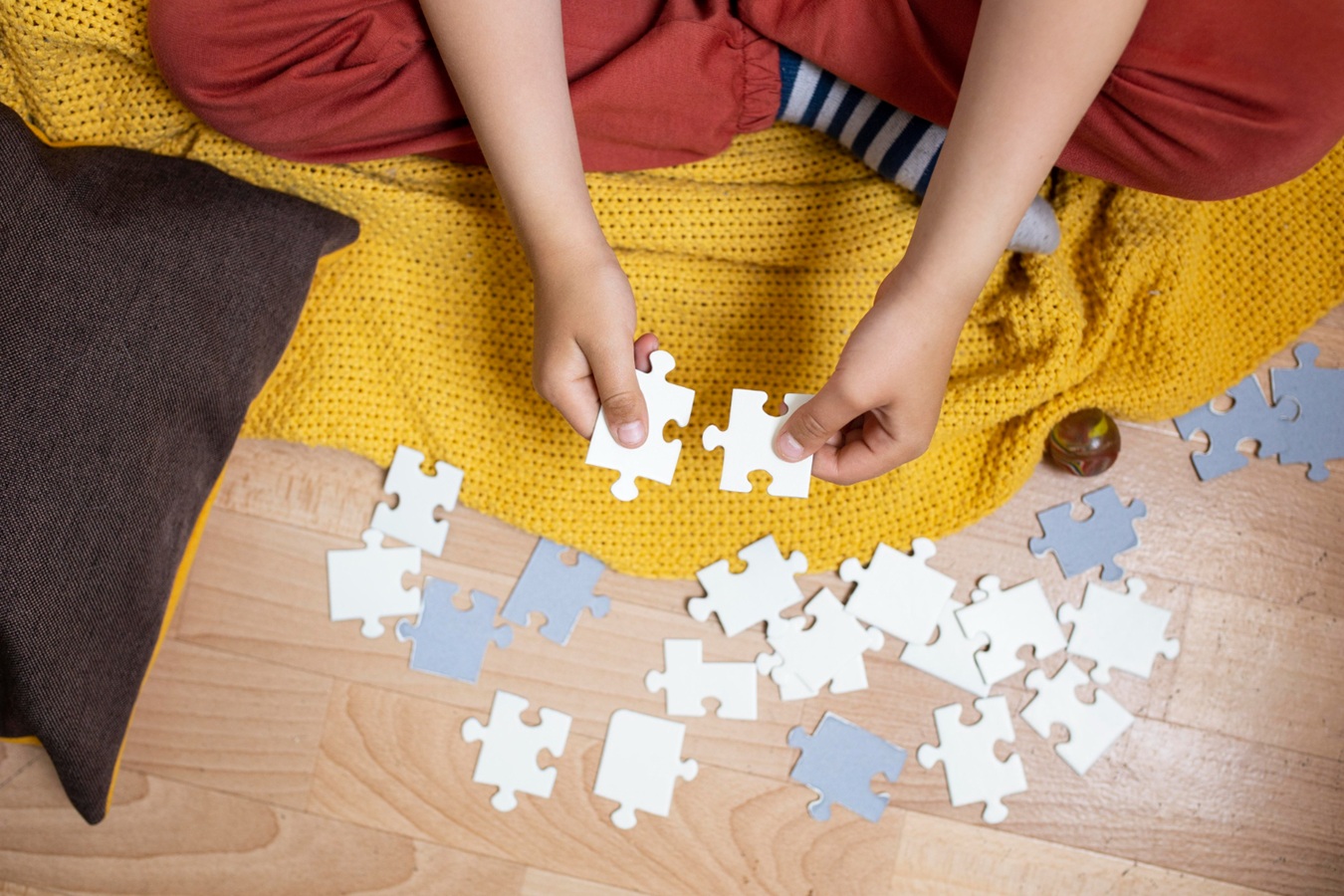
Desanomia [20.05.2026] Are you familiar with the game of arranging pictures? Most of us probably know it as a puzzle game. What is meant here is a game of arranging separated small pieces in order to form a complete picture that has already been provided beforehand. In this game, the final image is already known, whether through the example printed on the box, a visual reference, or a design predetermined by its maker. Because of that, the player does not move without direction. From the very beginning, there is a clear goal: to arrange all the pieces so that they return to becoming a complete image.
Perhaps rarely do people step back and reflect upon the meaning behind such a game. For example, we may observe that every puzzle piece has its own place. No piece is completely free to be placed anywhere. The shape of the edges, colours, lines, shadows, and image fragments on each piece become clues that guide the player towards the correct position. Puzzle is not just about attaching parts together, but about reading signs within the framework of the image that serves as its goal.
What deeper meaning may be found here? Through this game, we may understand the place of a piece within the whole, and conversely the meaning of the whole within its pieces. The game demonstrates the relationship between part and entirety. A single piece has almost no meaning in itself. It may appear only as a slight streak of colour, a curved line, or a fragment of form that is difficult to recognise. Yet when placed in the correct position, the piece gains meaning because it becomes part of the complete picture.
Here it becomes visible that meaning does not always reside in the part itself, but in relation. A puzzle piece becomes meaningful because it is connected to other pieces. Misplacing one piece may disturb the arrangement of the whole. In other words, within a puzzle, the correctness of a part is determined by its suitability within a larger structure.
To a certain extent, puzzle games also teach that order may emerge from what initially appears chaotic. When the pieces are scattered across a table, what first appears is a small disorder. Yet this disorder is not absolute chaos, because every piece already carries within it the possibility of order. The task of the player is to rediscover the hidden order behind the fragmentation.
Because the final picture is already available, puzzle games possess a clear measure of success. A player succeeds when all the pieces are arranged according to the complete image. A player fails, or has not yet finished, when there are still pieces that have not found their place, or when some parts are incorrectly arranged. In this case, puzzle has a relatively clear goal, procedure, and standard of evaluation.
Perhaps we may say that behind all of this lies a powerful message: in many aspects of life, human beings often require an “end picture” in order to direct their actions. When the goal is visible, the process becomes easier to undertake. Players compare small pieces with the larger image, then determine whether a certain piece fits or not. The final image functions as orientation.
Yet puzzle also shows that knowing the goal does not necessarily mean knowing the path towards it. The final image may already exist, but the player must still work, experiment, compare, turn, move, and correct. Knowledge of the whole does not automatically solve the problem of the parts. Between knowing the picture and constructing the picture, there remains a process.
Because of that, puzzle contains within it a discipline of patience. Not all pieces can immediately be recognised. Some sections are easy to arrange because their colours are obvious, while others are difficult because their forms and colours appear similar. The player must accept that the complete image can only be achieved through gradual effort, not through instant leaps.
More deeply, this simple game contains a lesson about the interdependence of parts. A single piece cannot impose its own place. It is only correct when positioned in harmony with other pieces and with the overall image. Puzzle therefore demonstrates that success is not the result of isolated parts standing alone, but of the ability to place each part within the proper arrangement.
Puzzle games become a small illustration of how fragmentation may be directed towards wholeness. They contain a clear goal, an available final image, rules of compatibility, and standards of success or failure. Above all, it is important for us to realise deeply that parts only become meaningful within relations, order must be sought through patience, and wholeness emerges only when every piece finds its proper place.
What do you think? (njd)
Note: This article was made as part of a dedicated effort to bring everyday life around us to our minds.